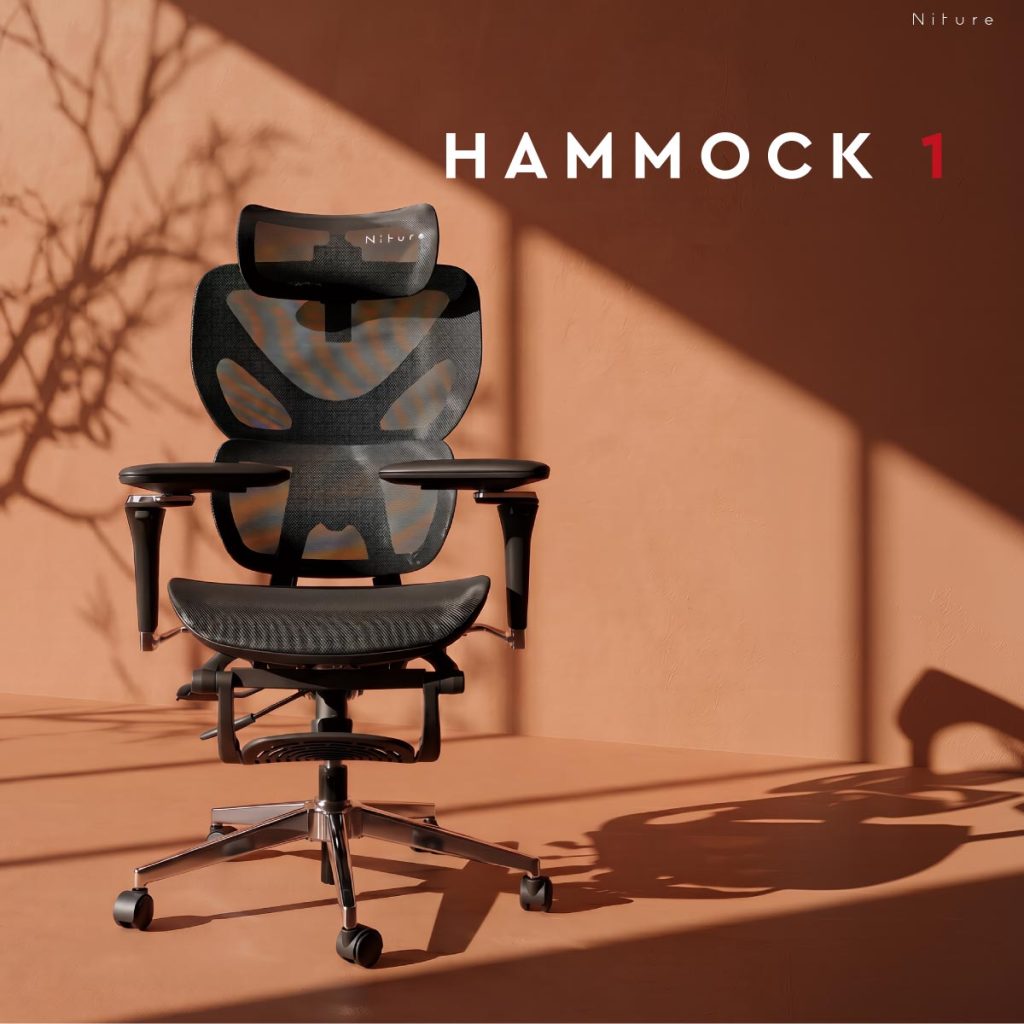
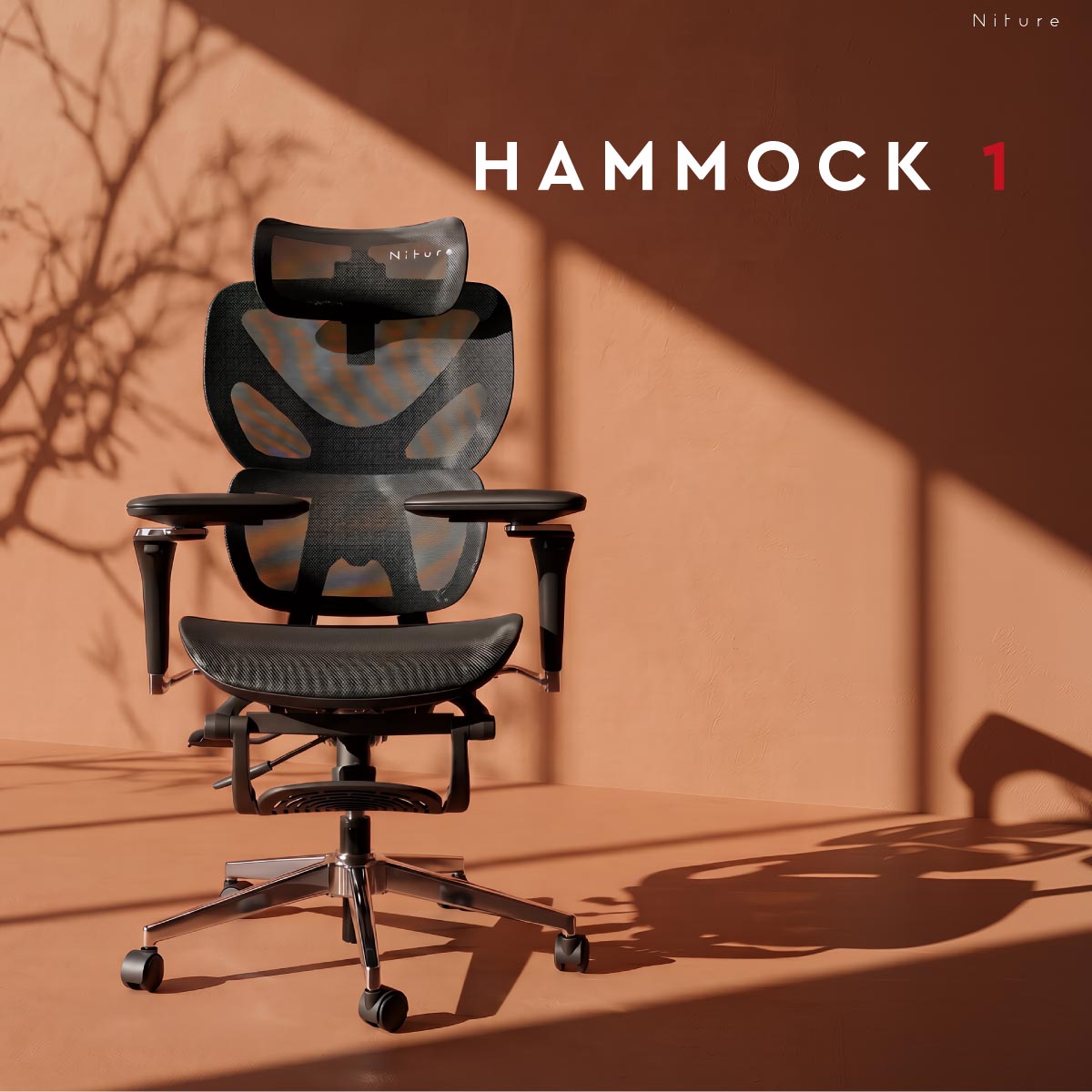
Hammock 1 Ergonomic Chair
Niture Hammock Series

Hammock 1 Ergonomic Chair Focused support, felt where it matters.

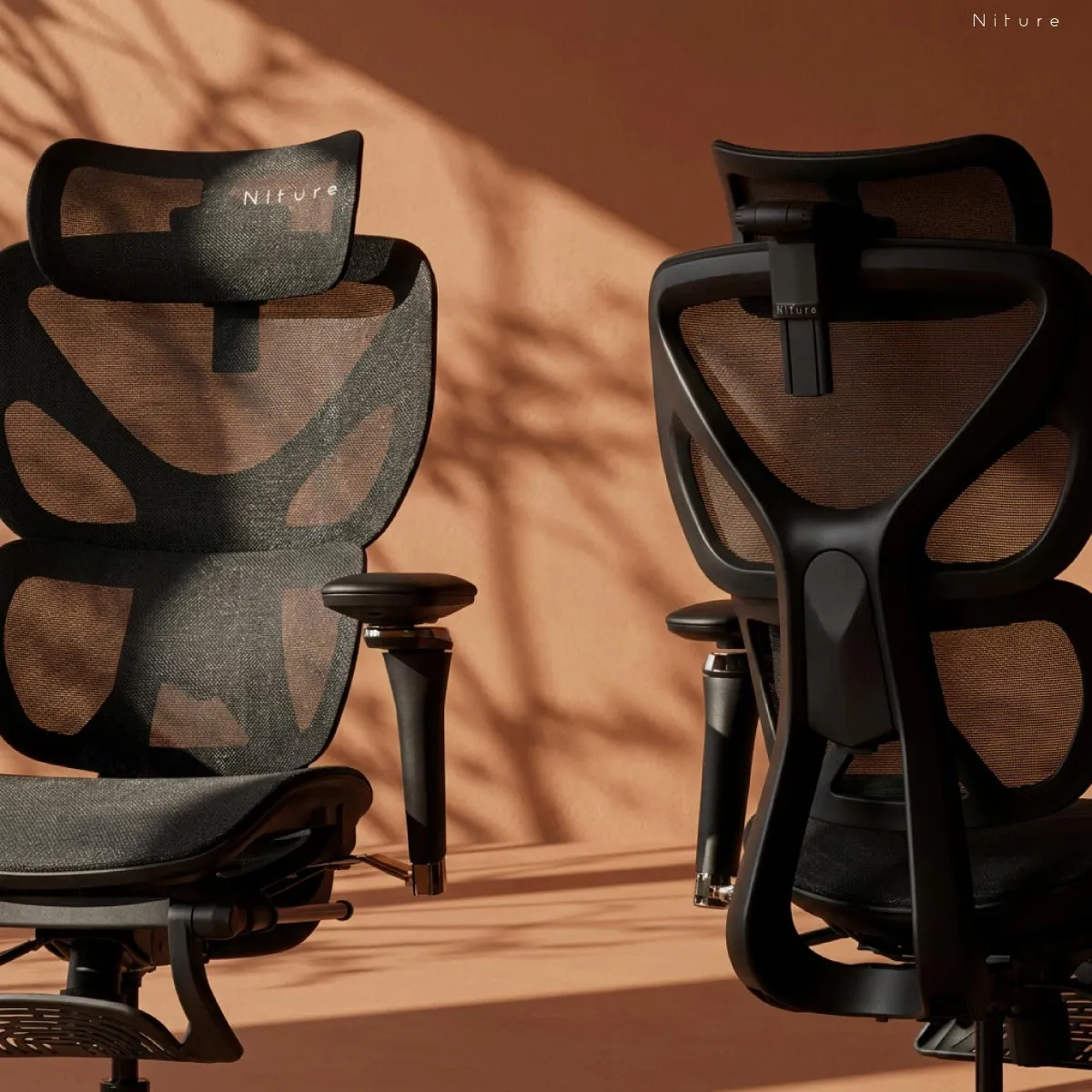
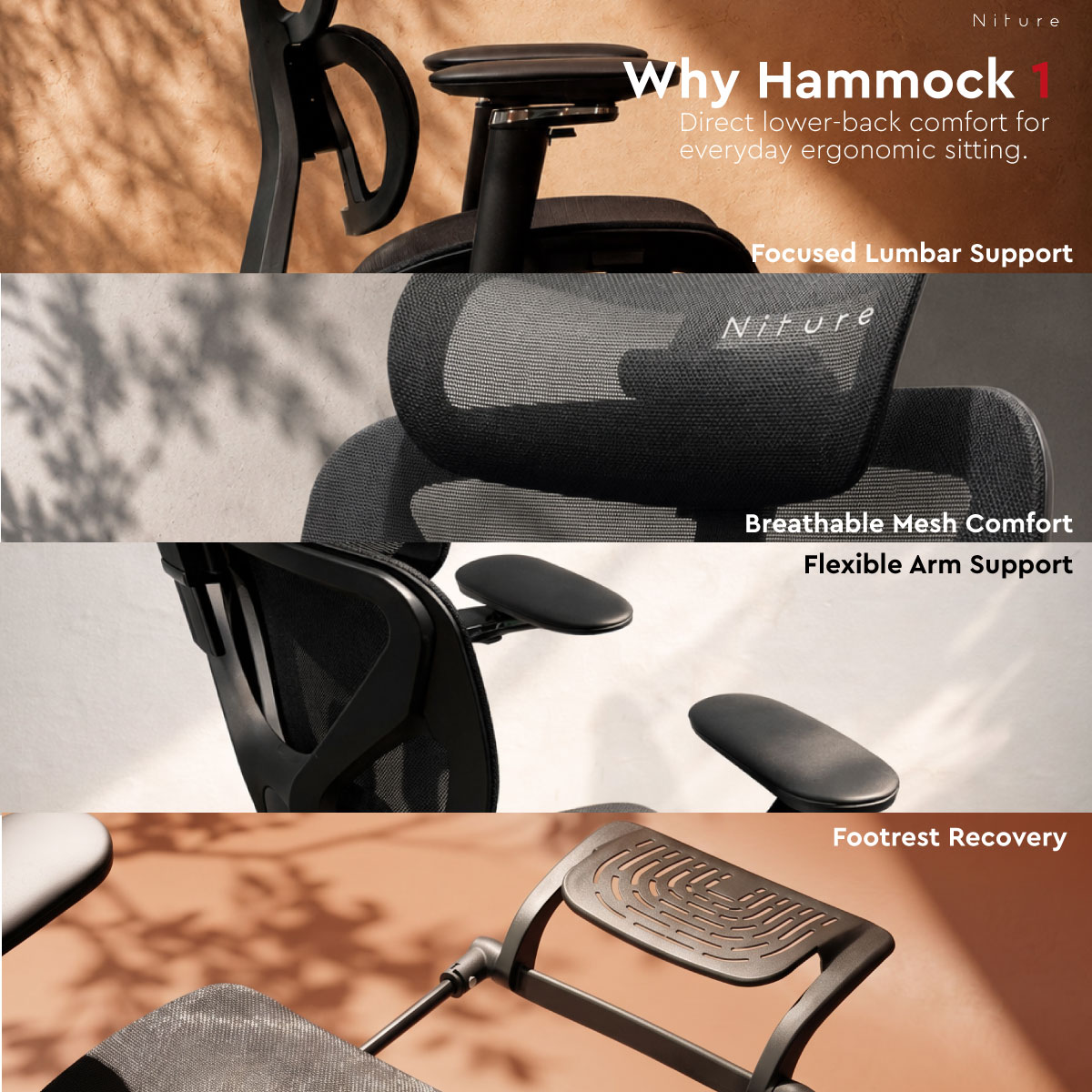
Niture Hammock 1 is a full-mesh ergonomic chair with Flex-Control Lumbar Support: one curved lumbar piece that gives focused lower-back contact, set fixed or allowed to flex up to approx. 30°.

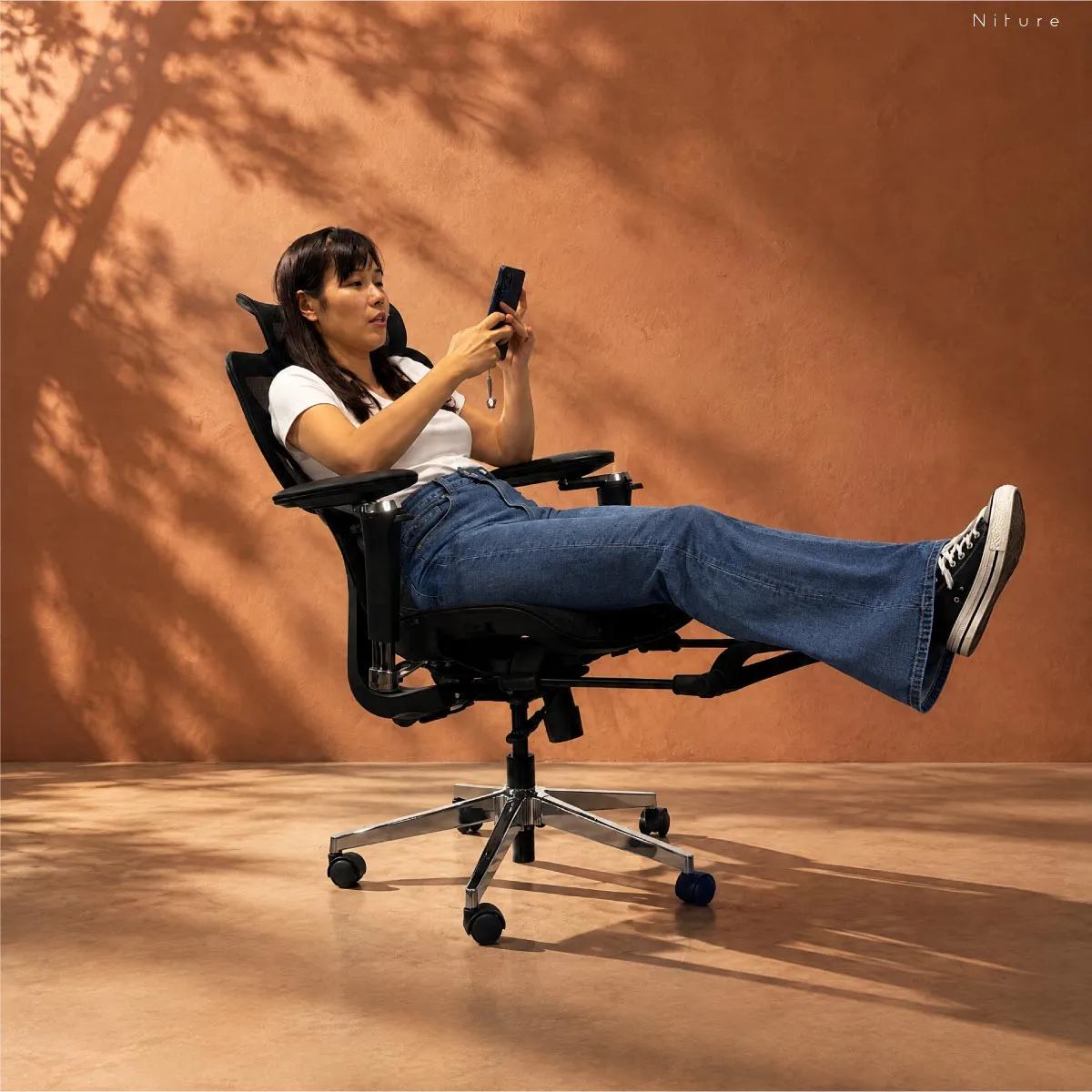
It adds 3-position seat depth, a 4D headrest, 5D Dual-Axis armrests, synchronized recline with 3 locks up to approx. 135°, a retractable footrest and a 3-year warranty.

Lumbar
Flex-Control
Single curved piece · fixed or up to ≈30° flex
Fit Starting Point
≈158–180 cm
Marginal at 158 cm; depends on torso length
Usable Seat Depth
≈44–50 cm
From lumbar contact · 3 positions
Maximum Load
110 kg
Hammock Series recommended maximum
Try Hammock 1 in Puchong View Hammock 2

Free fitting · Walk-ins welcome · Mon–Sun, 11 AM–5 PM

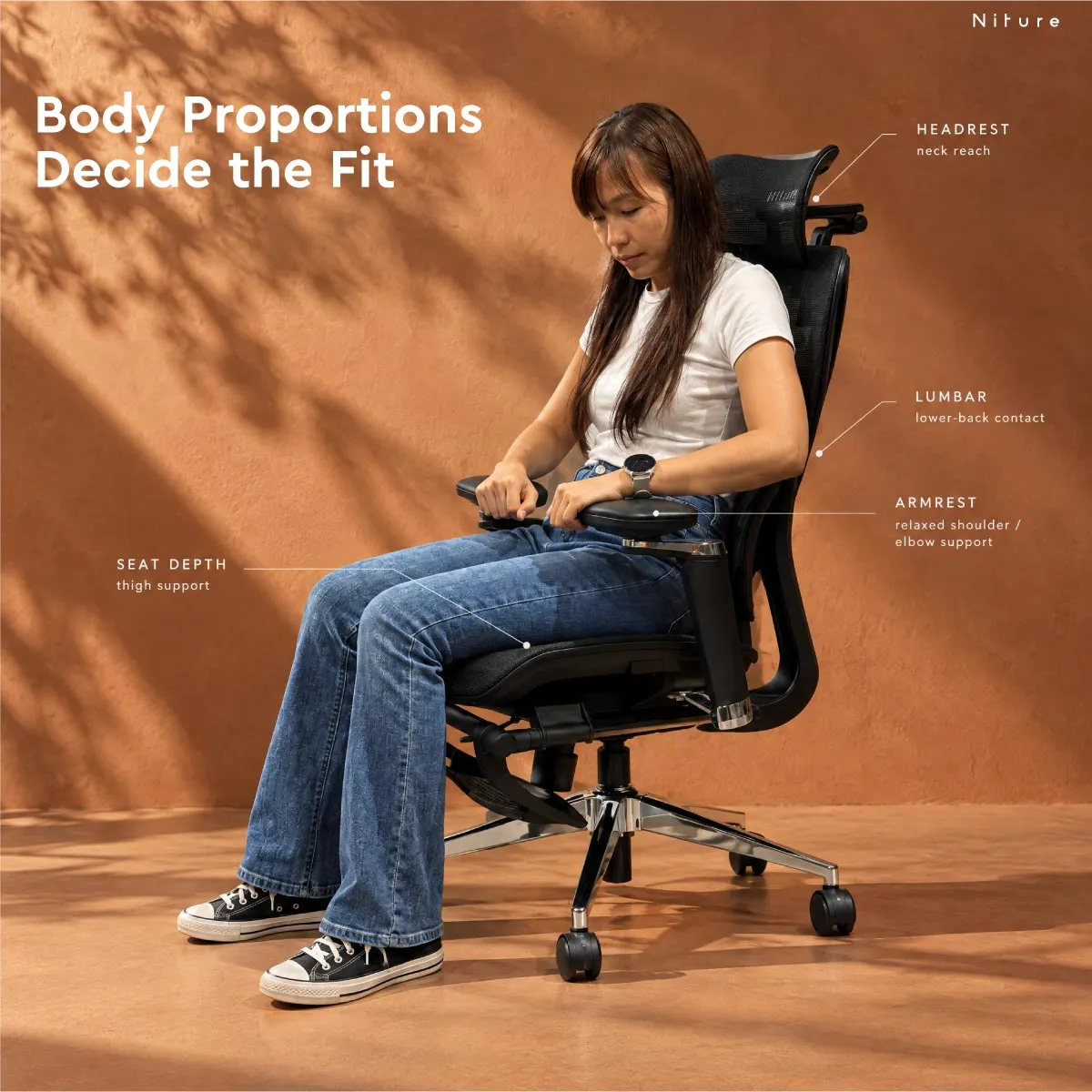
Height is only a starting point. Seat depth, thigh length, torso length, lumbar position, armrest reach and headrest position decide whether the chair fits your body. Compare all Niture chairs

Flex-Control Lumbar Support

One Curved Lumbar.
Focused Support You Can Set.

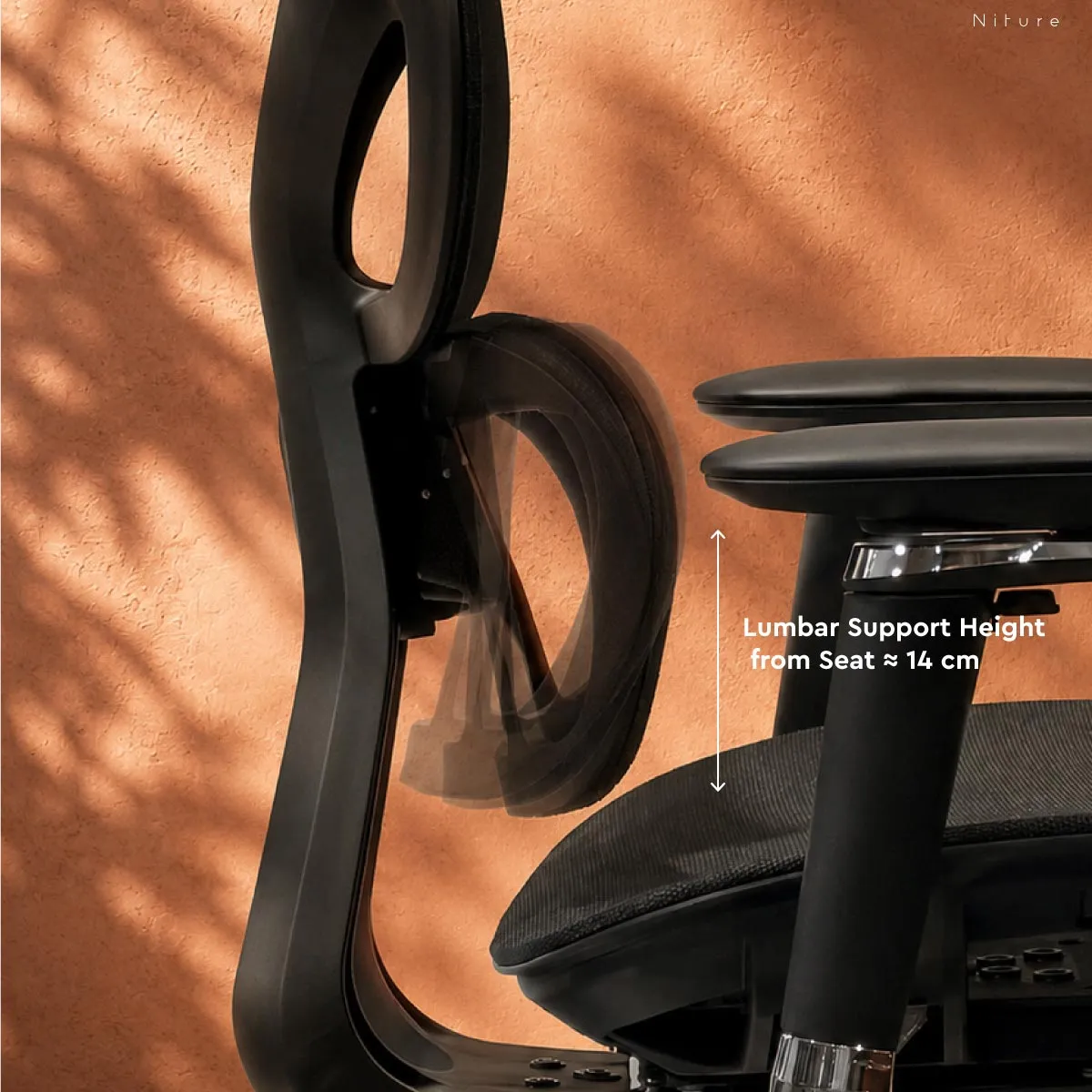
Hammock 1's lumbar support is a single curved piece. It concentrates contact on the centre of your lower-back curve, and a wheel at the back sets it fixed or lets it flex up to approx. 30°. This is the main difference from Hammock 2, which spreads support across twin lumbar sections.

Hammock 1 Flex-Control Lumbar Support, a one-piece curved lumbar with its contact point approximately 14 cm above the seat
The curved contact point sits approx. 14 cm above the seat surface.

How Flex-Control Works

Because the support comes from one curved piece rather than two sections, the contact feels more defined and easier to notice against the lower back.

Lumbar Height from Seat Approx. 14 cm

Measured from the seat surface to the curved contact point. Sit fully back to check where it meets your lower back.

Set it with the wheel at the back

  • Turn fully right Fixed

    The lumbar holds its position for firm, steady support.

  • Turn left Flex · up to ≈30°

    The lumbar pivots at its top edge and follows you as you move. The further you turn, the more it can flex.
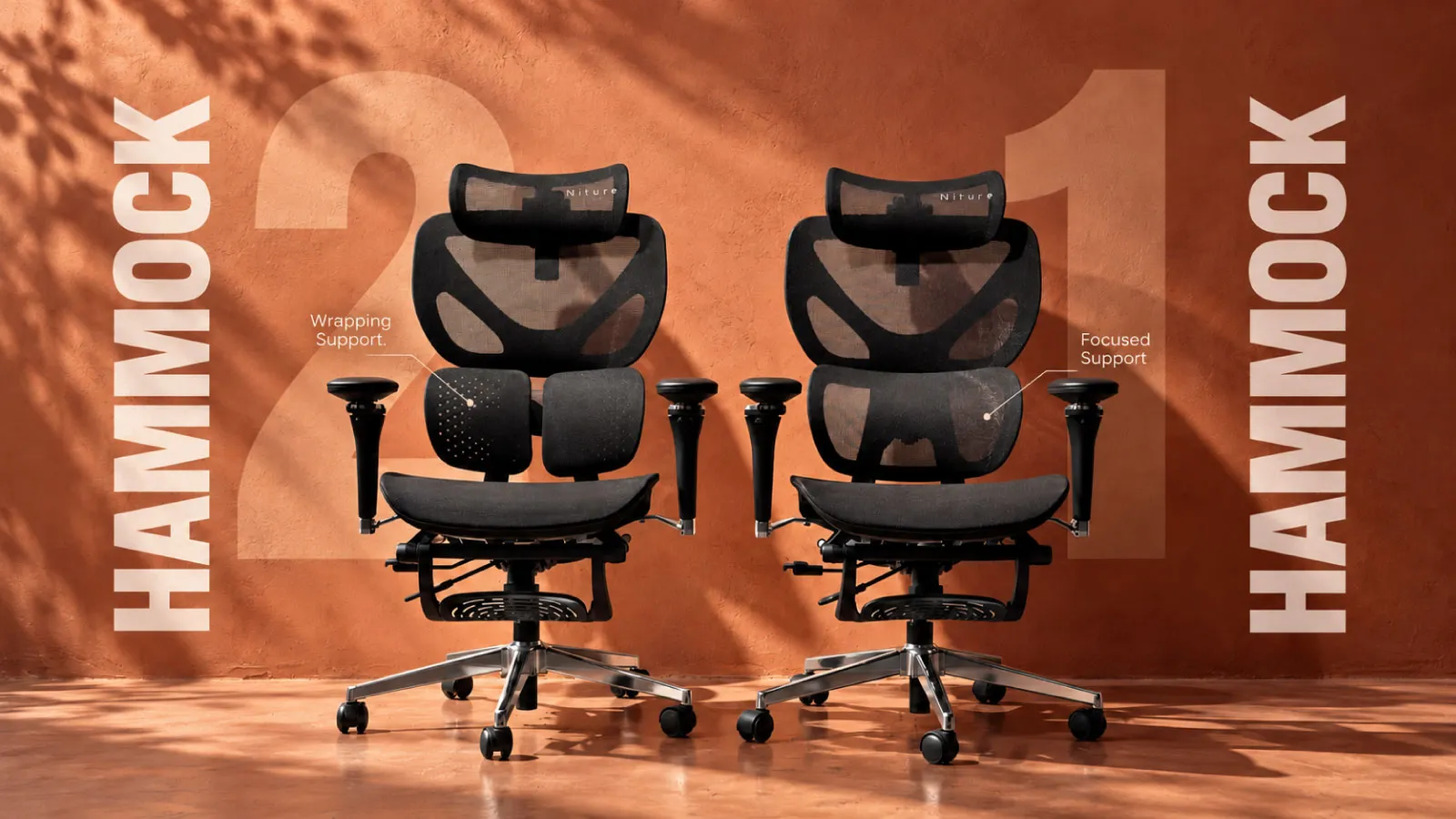
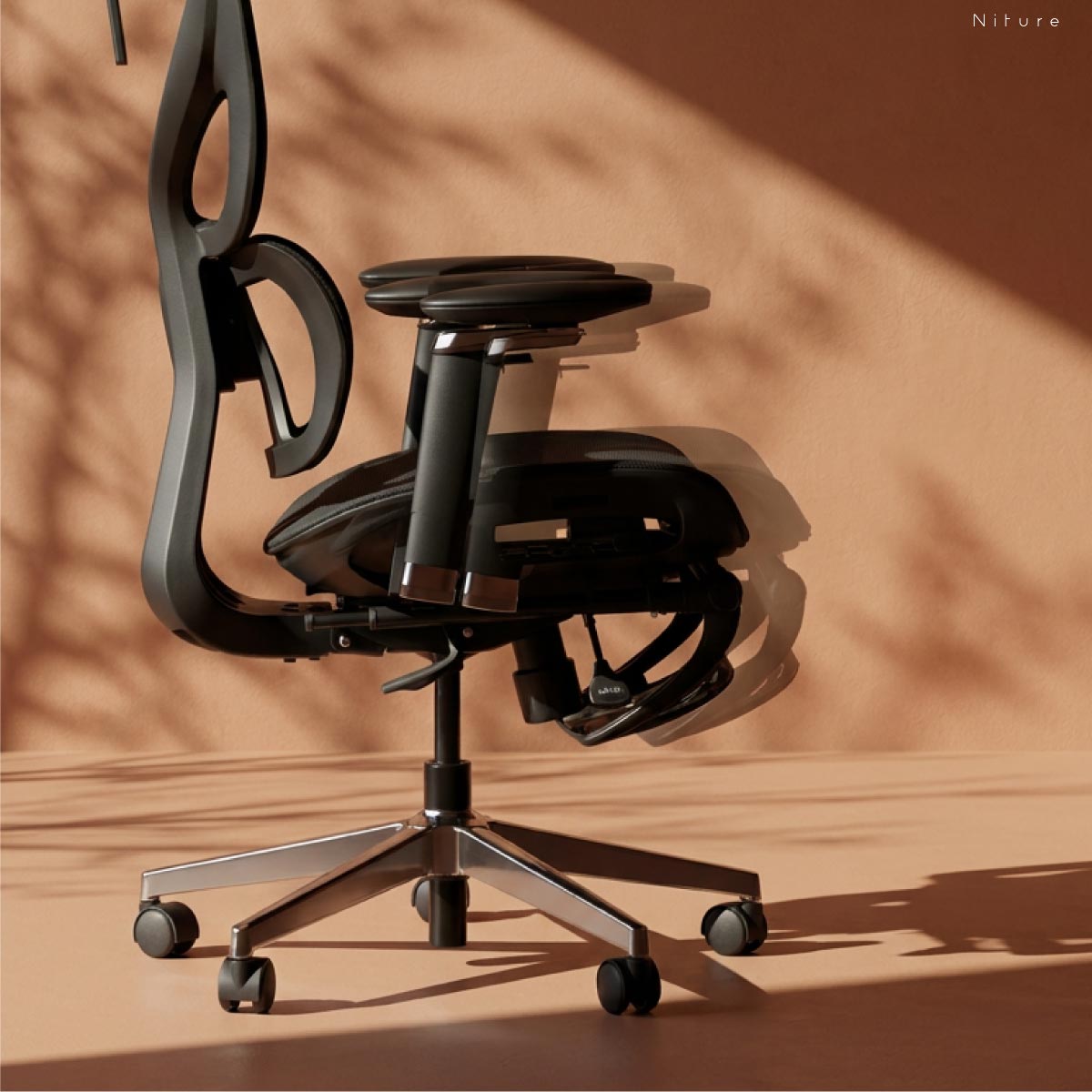
Hammock 1 vs Hammock 2

Hammock 1 is not the basic version of Hammock 2. Both use the same chair platform; the lumbar design is the main difference, and it changes how support feels against your lower back.

Hammock 1 single curved lumbar support beside Hammock 2 twin lumbar support
Where Hammock 1 and Hammock 2 differ
Feature Hammock 1 Hammock 2
Lumbar design One-piece curved lumbar Twin lumbar sections
Support feel Focused, concentrated, more noticeable Broader, wrapping, more embracing
Lumbar adjustment Wheel sets the flex: fixed, or flex up to ≈30° Rotary knob sets the depth: up to ≈2 cm forward
Lumbar contact from seat ≈14 cm (contact point) ≈8–25 cm (contact zone)
Usable seat depth ≈44–50 cm ≈43–50 cm

Swipe the table sideways to see both chairs.

What stays the same

  • 51 × 51 cm seat panSame physical seat size
  • Seat height ≈45–53 cmSame gas-lift range
  • 3-position seat depthSame slide mechanism
  • 4D headrestSame adjustment range
  • 5D Dual-Axis armrestsSame adjustment platform
  • Recline + footrest3 locks to ≈135° · retractable
Choose Hammock 1 if… You want to clearly feel one defined support point, and like the option to keep it fixed or let it flex.
Choose Hammock 2 if… You prefer support that spreads around the lower back, with a knob to bring it closer or ease it back.

Neither design is universally better. Body shape, lumbar curvature and personal preference decide which feels more natural. If you can, sit in both before choosing.

3-Position Seat Depth

Fit the Seat to Your Thigh Length

Hammock 1 gives approx. 44–50 cm of usable seat depth, measured from the lumbar contact point to the front edge of the seat, across 3 seat positions.

Slide the seat forward for more thigh support, or back for more space behind the knees. The goal is to support most of your thighs while your lower back stays against the lumbar support.

Usable depth from lumbar
44–50cm
Positions
3≈6 cm range
Seat pan
51 × 51 cmPhysical depth ≈50 cm
Hammock 1 seat depth adjustment with three positions, giving approximately 44 to 50 cm usable depth measured from the lumbar support

What the Right Seat Depth Feels Like

  • Too short Thighs left unsupported

    More of the thigh hangs past the seat edge, so weight concentrates on a smaller area.

  • Right fit Thighs supported, knees clear

    Most of the thigh rests on the seat, with a small gap behind the knees and your back on the lumbar.

  • Too long Pressure behind the knees

    The seat edge presses into the knees, or you perch forward and lose contact with the lumbar.

Check It in Under a Minute

  1. Sit fully back

    Push your hips to the back of the seat so your lower back meets the lumbar support.

  2. Check behind your knees

    You should be able to slide a few fingers between the seat edge and the back of your knee.

  3. Move one position and compare

    Try the next seat position. Keep the setting that supports most of your thigh without knee pressure.

How we measure

Usable seat depth · ≈44–50 cm
From the effective lumbar contact point to the front edge of the seat, across the 3 seat positions. This is the depth your thighs actually use.
Physical seat pan · 51 × 51 cm
The seat's own width and depth. Its physical depth measures approx. 50 cm. Physical size and usable depth are different numbers.

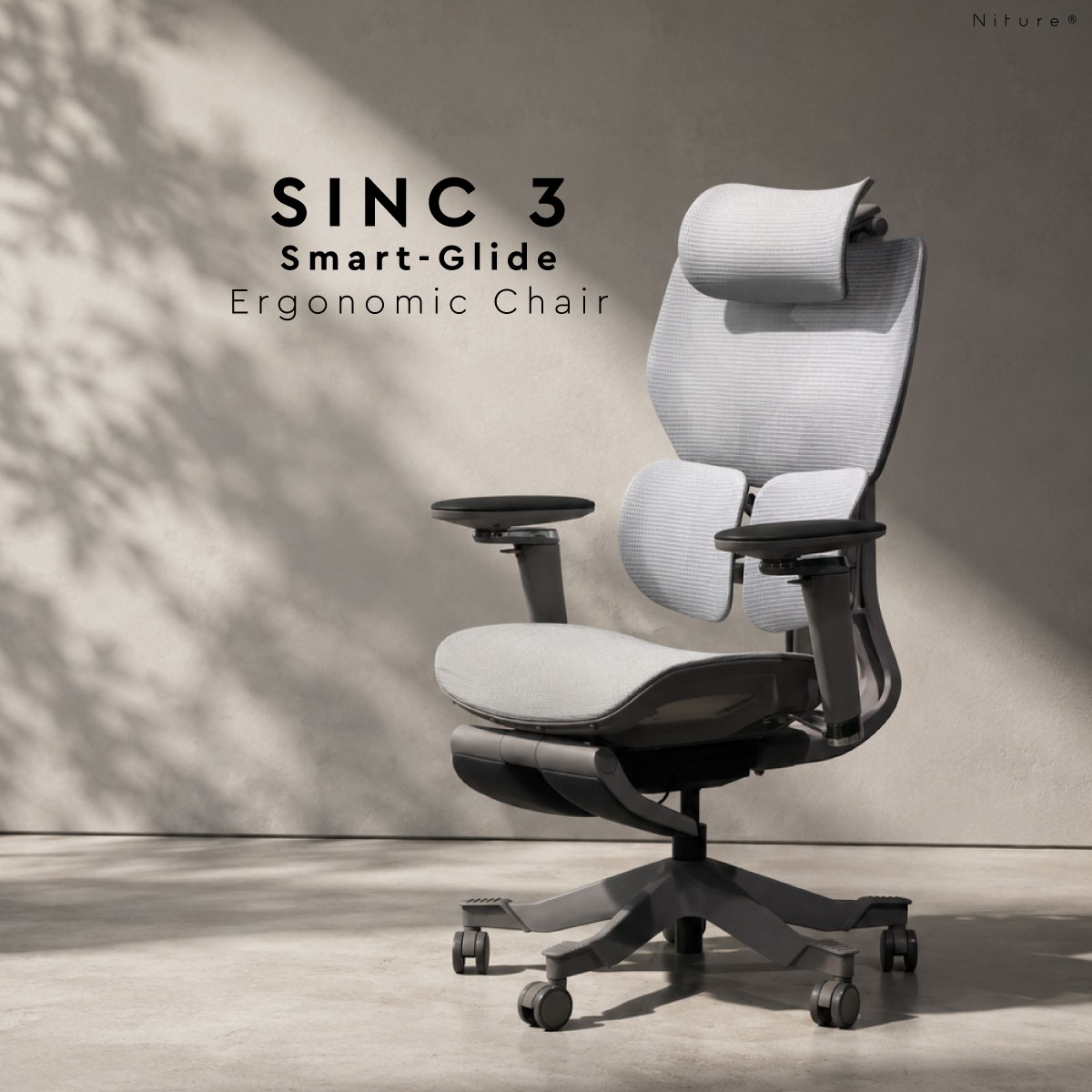
Shorter thighs? If the rearmost position still presses behind your knees, Hammock 1 may be too deep for you, regardless of your height. SINC 3 (≈40–46 cm) and SINC Air (≈40–51 cm) offer shorter usable depths. Compare all Niture chairs

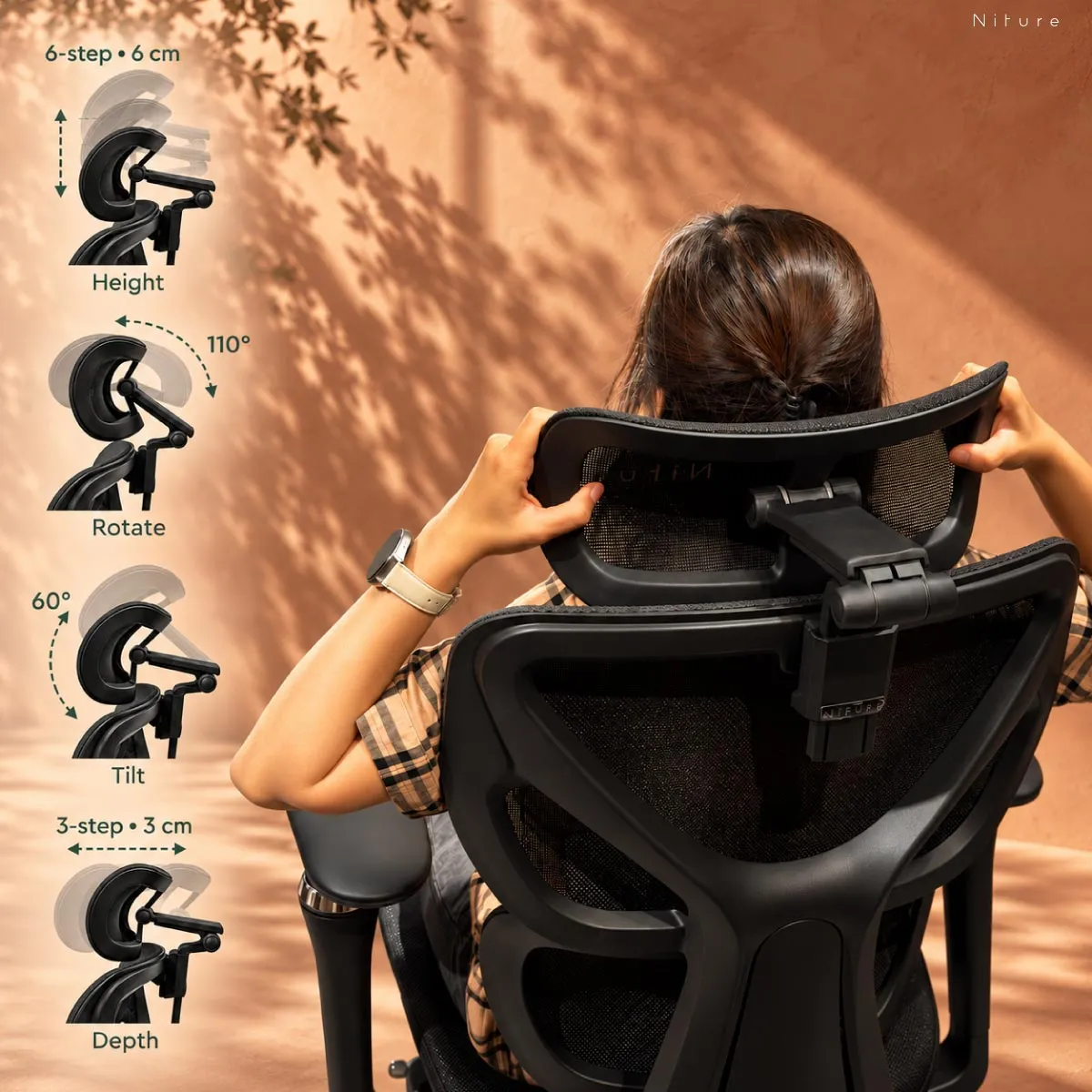
Hammock 1 4D headrest showing its height, depth, tilt and rotation adjustments
4D Neck-Focused Headrest

Position the Headrest Around Your Neck

Hammock 1's 4D headrest adjusts in four directions: 6 cm of height in 6 steps, 3 cm of depth in 3 steps, 60° of tilt and 110° of rotation. Together they bring support to your neck curve, not just behind your head.

Height
6 steps · 6 cmLine it up with your neck, whatever your torso length.
Depth
3 steps · 3 cmBring it closer without pushing your head forward.
Tilt
60°Match the angle of your neck, upright or reclined.
Rotation
110°Fine-tune where it meets the neck and lower head.
Headrest Height from Seat Approx. 59–80 cm

From the seat surface to the headrest reference position. Compare it with the distance from your seat to the base of your neck.

Check Headrest Fit in Three Steps

  1. Set the height first

    Sit fully back. Raise or lower the headrest until it meets the curve of your neck, not the back of your skull.

  2. Bring it closer, gently

    Add depth until you feel light contact without leaning back. If it pushes your head forward, reduce the depth or change the tilt.

  3. Recheck when you recline

    Your neck angle changes as you lean back. Use tilt and rotation to keep support in each recline position.

Torso length matters more than height. Two people of the same height can need different headrest positions. On Hammock 1, the headrest's 6 cm height range is what matches it to your torso. If you have a long torso and the headrest can't reach your neck, SINC models also let you adjust backrest height. Compare all Niture chairs

5D Dual-Axis Armrests

Bring the Armrests to Your Arms

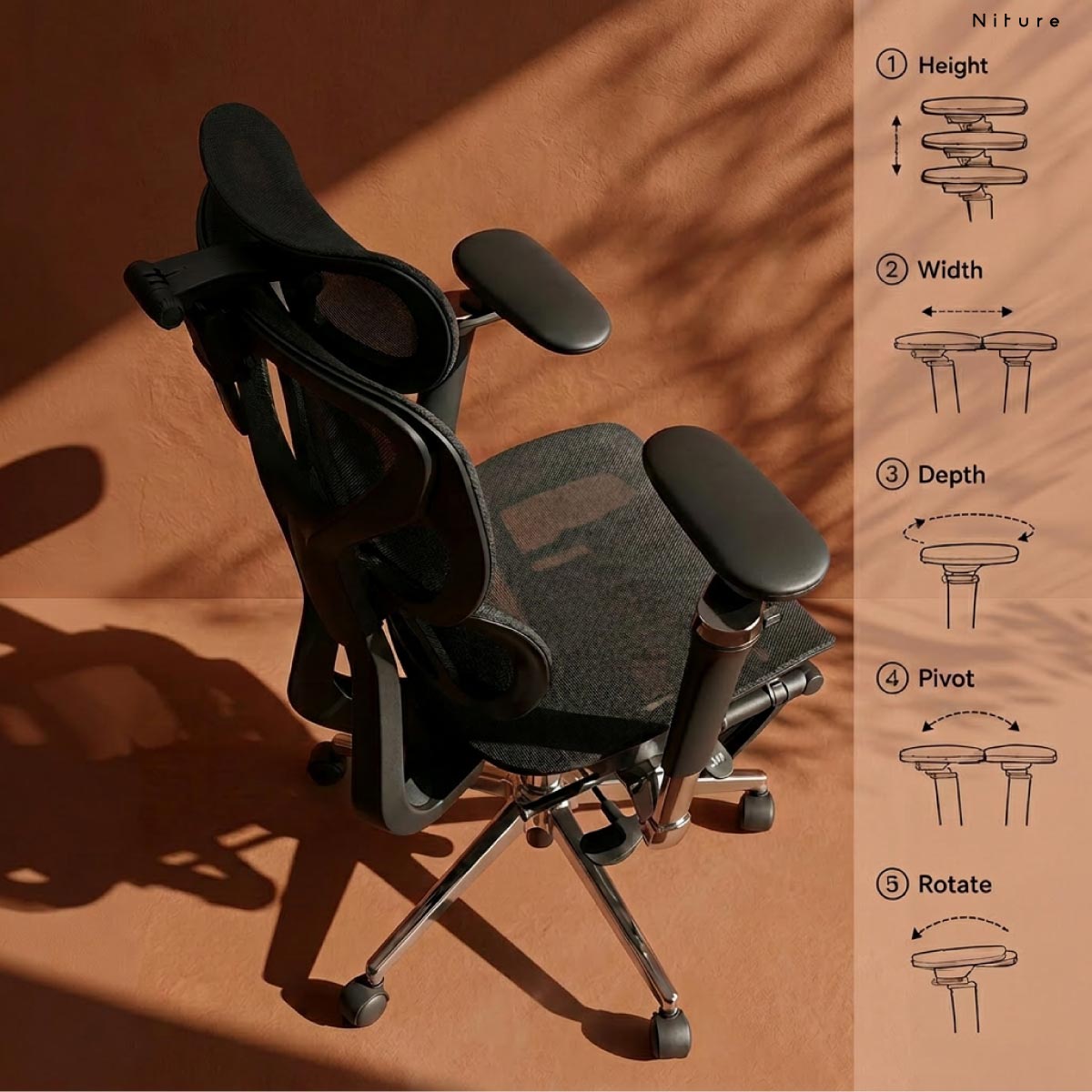
Hammock 1's 5D Dual-Axis armrests move in five ways, with up to 54 cm of fore–aft reach. Instead of a short sliding pad, two pivot joints move the whole armrest, so support can follow your elbows for typing, mouse work, phone use or reclining.

Height
7 steps · 9 cm
Support the forearms without lifting the shoulders.
Width
Up to 13 cm
Bring the arms in or out to suit your shoulder width.
Pad rotation
360°
Angle the pad for work or relaxed positions.
Pivot
Up to 270°
Swing the armrest toward where your forearms rest.
Fore–aft reach
Up to 54 cm
Two axes reposition the whole armrest forward or back.
Hammock 1 5D Dual-Axis armrest showing height, width, pad rotation, pivot and fore-aft reach
Armrest height from seat
≈20–29 cm
Inner armrest width
≈38–64 cm

Approximate fitting measurements. Confirm your armrest position during a chair fitting.

What "Dual-Axis" Means

The forward and backward movement doesn't come from sliding the pad along a track. Two rotating joints work together to move the whole armrest, which gives a much wider reach and lets the pad approach your body from different angles.

  • First axis

    Swings the armrest assembly to a new position.

  • Second axis

    Extends that range further forward, backward or inward.

Check Armrest Fit in Three Steps

  1. Set seat and desk first

    Adjust armrests last, once your seat height and desk position are right.

  2. Relax the shoulders

    Raise the armrests until your forearms rest on them without shrugging, and lower them if your shoulders lift.

  3. Keep elbows close

    Use width and reach to bring the pads under your elbows. Move them again when you switch tasks or recline.

Fit tip: Armrests should hold your forearms, not push your shoulders up or your elbows away from your body. If you work at a fixed desk, check that the armrests can sit level with the desk surface.

Hammock 1 seat height adjustment from approximately 45 to 53 cm
Adjustable Seat Height

Set Your Sitting Height Around the Desk

Hammock 1's seat measures approx. 45–53 cm from the floor when empty, and approx. 39.5–47.5 cm once you sit on it, because the mesh seat gives under your weight.

Use the seated figure to judge fit. Your feet should rest flat with your knees comfortable, and your forearms should reach the desk without lifting your shoulders.

Empty chair
45–53cmFloor to seat front edge, unloaded
When seated
39.5–47.5cmMeasured with a 75 kg adult seated

≈8 cm of continuous travel · TÜV-certified Class 4 gas lift

What the Right Seat Height Feels Like

  • Too low Knees sit higher than hips

    Hips and knees bend more, and the desk can end up too high for your forearms.

  • Right fit Feet flat, shoulders relaxed

    Feet rest on the floor, thighs sit roughly level, and elbows settle comfortably at the desk.

  • Too high Feet lose support

    Feet dangle or only the toes touch, and pressure builds under the thighs.

Set It in Three Steps

  1. Feet first

    Adjust the height until your feet rest flat on the floor with your thighs roughly level.

  2. Then check the desk

    With your legs set, see whether the keyboard sits near elbow height.

  3. Fix the desk, not your feet

    If the desk is too high, don't raise the chair until your feet hang. Lower the desk or add a foot support.

How we measure

Empty chair · ≈45–53 cm
Floor to the top of the seat at its front edge, lowest to highest setting, with nobody sitting.
When seated · ≈39.5–47.5 cm
Measured at the Niture showroom with the same 75 kg adult on a rigid plank across the seat, from the floor to the plank's underside at the seat front edge, lowest to highest setting. Use this to compare Niture chairs fairly.

Feet still don't reach the floor at the lowest setting? Use a separate foot support for desk work. The built-in retractable footrest is for reclined rest, not for making up seat height. Compare seat heights across Niture chairs

Synchronized Recline + Retractable Footrest

Move from Focused Work to Relaxed Sitting

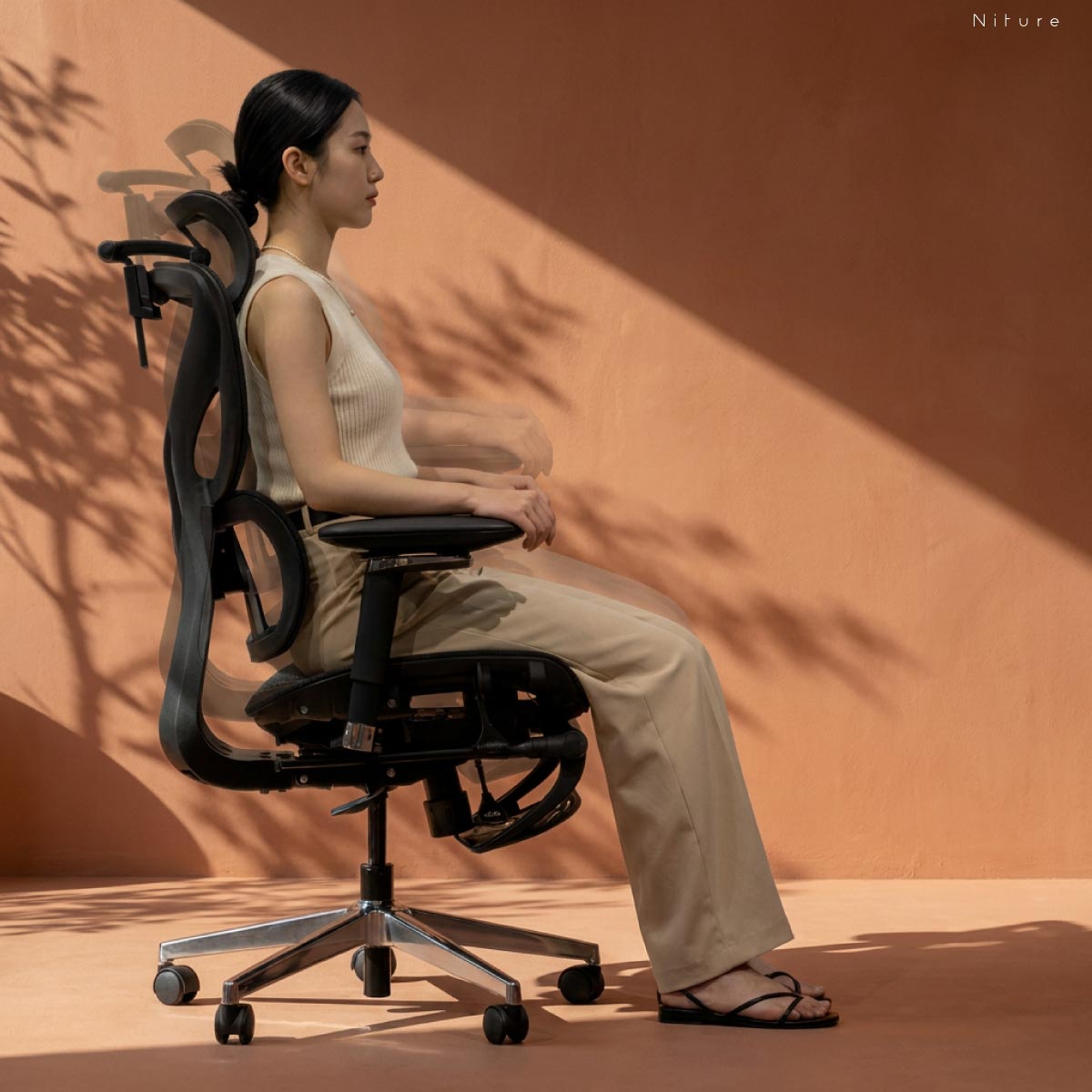
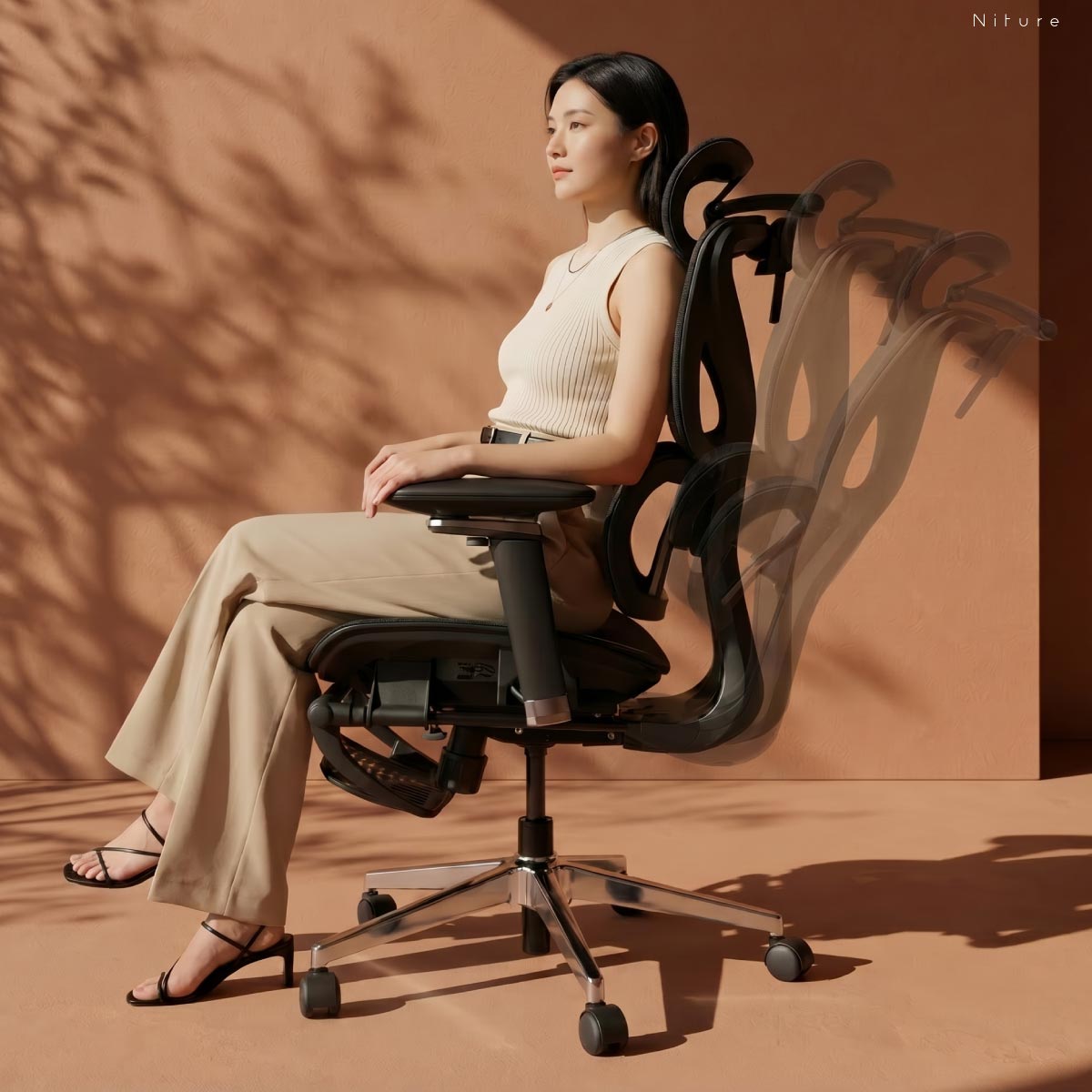
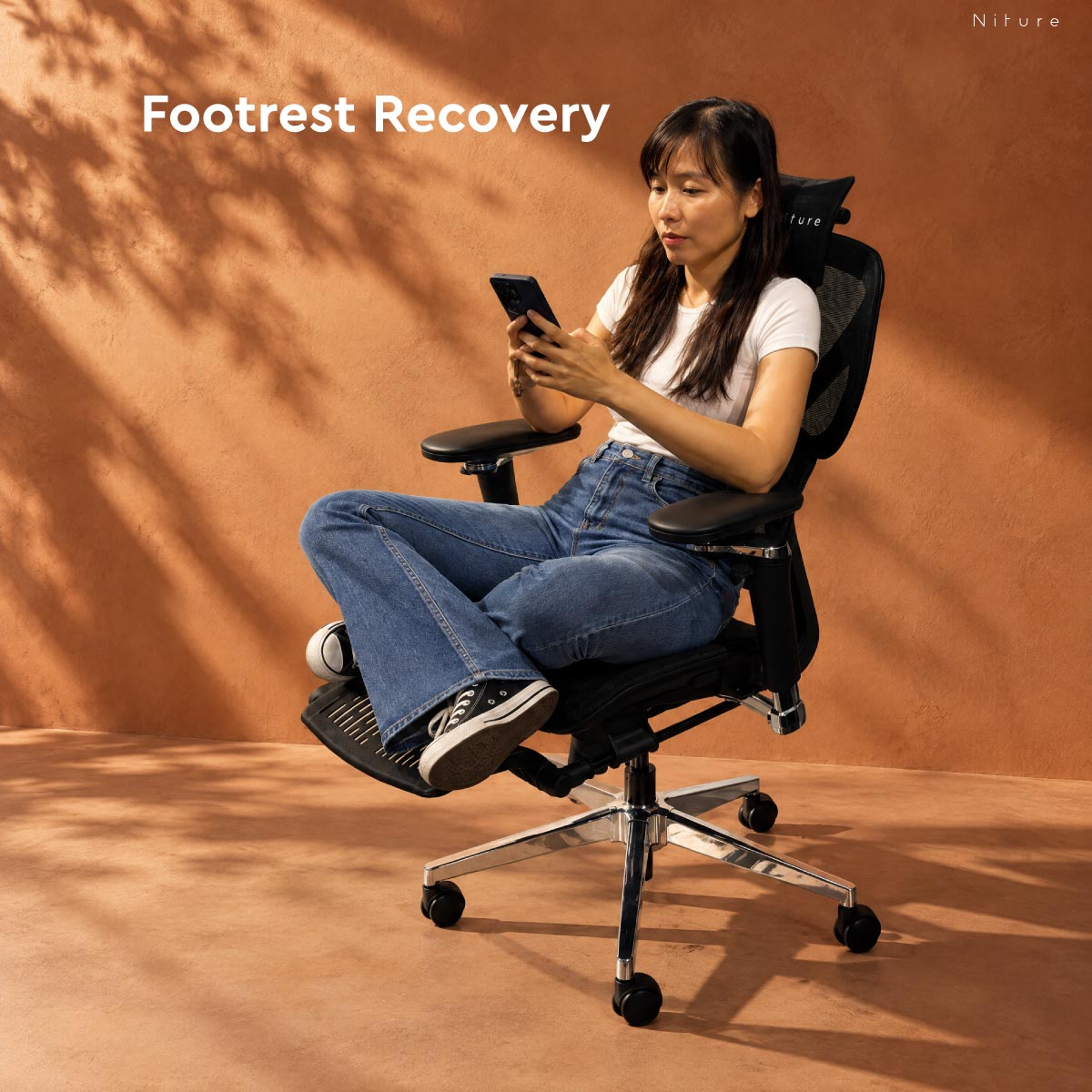
Hammock 1 reclines up to approx. 135° with 3 locking positions, and a footrest slides out from under the seat when you want to rest your legs. It gives you supported positions besides sitting upright all day, with a tension knob to set how firmly the backrest resists you.

Hammock 1 synchronized recline showing three locking positions up to approximately 135 degrees

Synchronized Recline

As you lean back, the seat and backrest move together in a coordinated motion, rather than the backrest simply folding back on its own. A tension knob sets how much resistance you feel as you lean back, so lighter and heavier users can both recline with control.

Maximum
≈135°
Locks
3
Mechanism
Synchronized
Tension
Adjustable knob
  1. Upright

    Typing, mouse work and close screen tasks.

  2. Mid recline

    Reading, calls and lighter tasks.

  3. Full recline

    Short breaks between focused work.

How we measure: the ≈135° is the angle between the seat surface and the backrest at full recline.

Hammock 1 retractable footrest shown stored under the seat and extended

Retractable Footrest

The footrest stores beneath the seat. Pull it out when you recline to support your lower legs, and push it back when you return to work.

  • Work mode Footrest stored

    Feet on the floor, or on a separate foot support, while you work at the desk.

  • Rest mode Footrest out

    Recline and stretch your legs for reading, calls or a short break.

Not a substitute for seat height: if your feet don't reach the floor while working, use a separate foot support rather than the built-in footrest.

Movement tip: recline and the footrest add more supported positions, but they don't replace moving. Change posture, stand up and walk regularly during long sitting sessions.

Breathable Mesh Comfort

More Airflow for Everyday Sitting

Hammock 1 uses breathable mesh on both the seat and the backrest. Air moves through it while you sit, which helps limit heat build-up in Malaysia's warm, humid conditions.

  • Cooler over long sessions

    Open mesh lets heat escape instead of holding it against your back and legs the way thick foam can.

  • Flexes under your weight

    The seat gives as you sit, so support comes from the stretched mesh rather than a dense cushion.

  • Sits about 5.5 cm lower when you sit

    Mostly from the mesh giving under you. That's why the seated height (≈39.5–47.5 cm) sits lower than the empty-chair height (≈45–53 cm).

Close-up of the Hammock 1 breathable mesh seat and backrest

Mesh or Cushion?

Neither is better for everyone. Mesh suits people who run warm and like a responsive, slightly springy seat. Foam suits people who want a softer, padded first feel.

How a full-mesh seat compares with a foam cushion
What you feel Hammock 1 mesh Foam cushion
Airflow High, air passes through Lower, can trap heat
First feel Firmer, springy Softer, padded
Under load Stretches and flexes Compresses
Suits Warm rooms, people who run hot People who prefer a plush seat

Swipe the table sideways to see both columns.

Comfort tip: mesh feel changes with body weight, clothing and how long you sit. If seat feel matters to you, sit on mesh and cushion chairs back to back before deciding. Try both at Niture Puchong

Body Fit

Height Is a Starting Point. Your Proportions Decide the Fit.

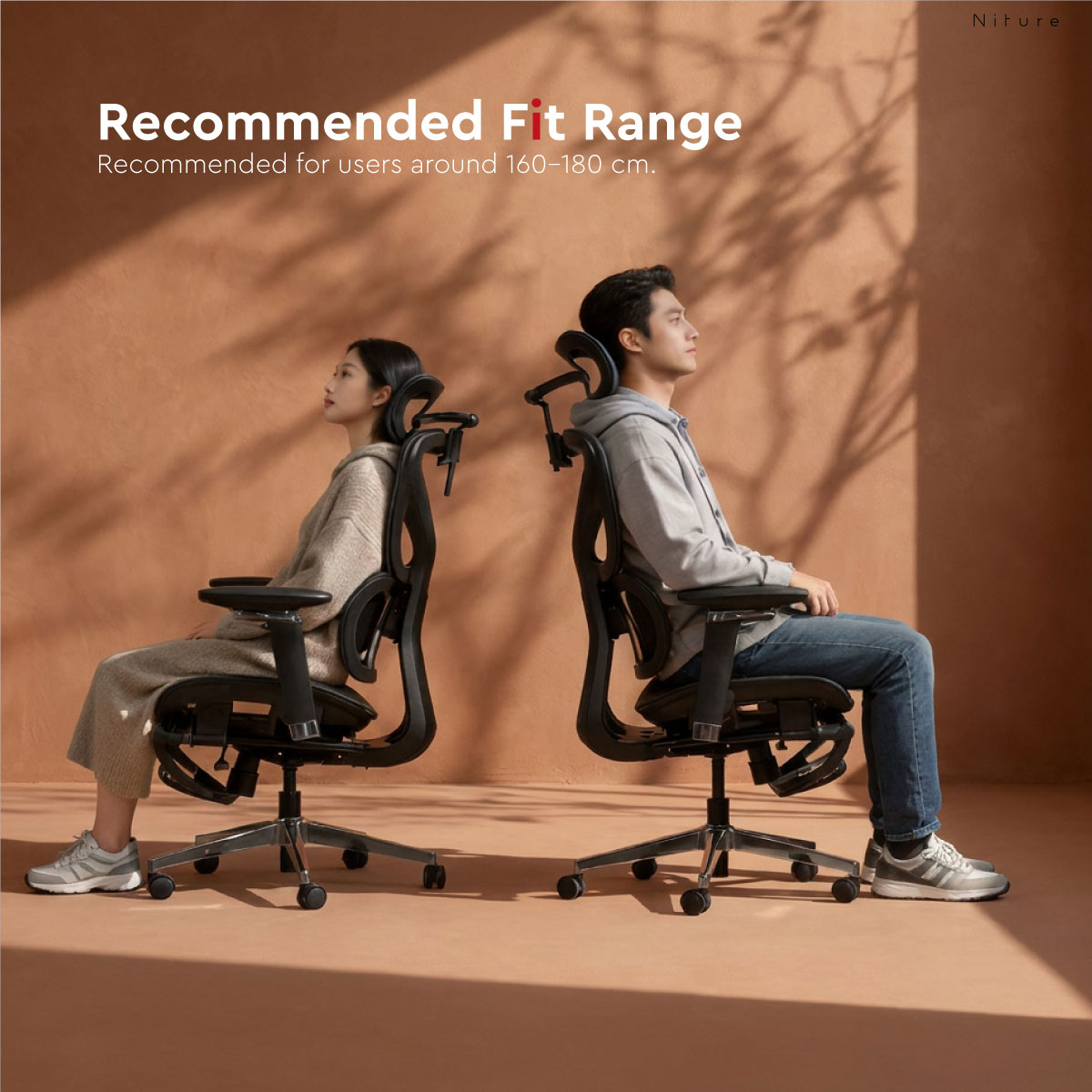
Hammock 1 generally suits people from about 158 to 180 cm, up to 110 kg. At around 158 cm the fit is marginal and depends on torso length. Two people of the same height can fit the same chair very differently, so check the six measurements below against your body.

Hammock 1 body fit points: seat depth, lumbar support, armrests and headrest

How to Read the Height Guide

  • Below ≈158 cm Try before buying

    Check seated seat height, usable seat depth and headrest reach closely. A SINC model may fit better. Read the guide for shorter users

  • ≈158–180 cm Recommended range

    The general fit range for the Hammock Series. Near 158 cm, torso length decides whether the lumbar and headrest land in the right place.

  • Above ≈180 cm Check reach

    Confirm thigh support at the longest seat depth and that the headrest reaches your neck. SINC models add backrest-height adjustment.

Six Measurements to Check Against Your Body

All values are approximate and measured at the Niture showroom. Tap a measurement to jump to its full explanation.

Hammock 1 fitting measurements
Measurement Hammock 1 What to check on yourself
Seat height, seated ≈39.5–47.5 cm Feet flat on the floor with thighs roughly level. Empty chair: ≈45–53 cm.
Usable seat depth ≈44–50 cm A few fingers' gap behind the knee with your back on the lumbar.
Lumbar height from seat ≈14 cm The curved contact point should meet the inward curve of your lower back.
Armrest height from seat ≈20–29 cm Forearms supported without lifting your shoulders.
Inner armrest width ≈38–64 cm Pads close to your elbows, not pushing your arms outward.
Headrest height from seat ≈59–80 cm Reaches the curve of your neck without pushing your head forward.

Swipe the table sideways to see all columns.

Technical Specifications

Hammock 1 Specifications

Construction and adjustment specs for Hammock 1. For the six measurements to check against your body, see Body Fit.

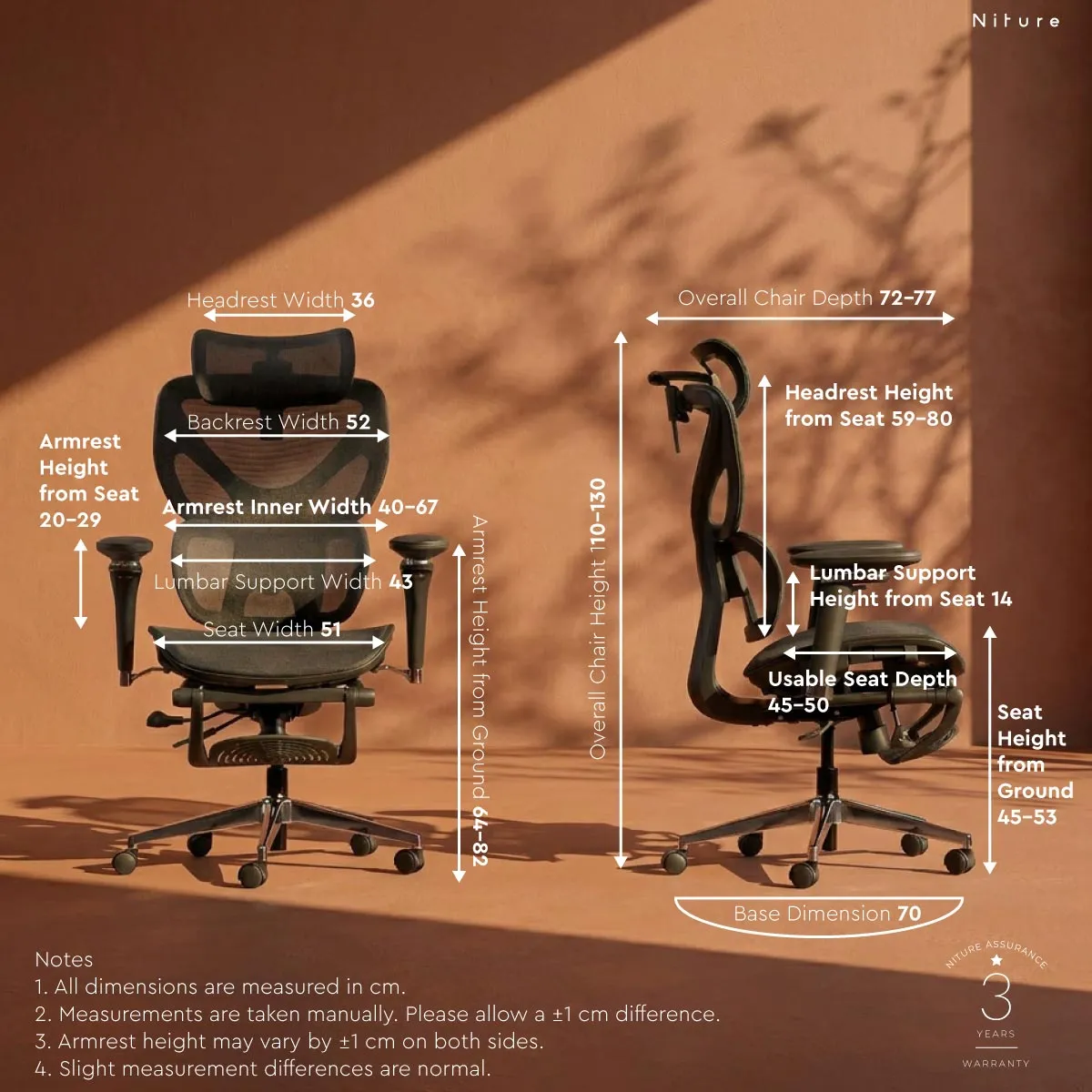
Hammock 1 ergonomic chair dimension drawing
Dimension drawing. Values are approximate.
Full specification table
Hammock 1 full specification
General
SeriesNiture Hammock Series
Recommended user height≈158–180 cm (marginal at 158 cm)
Maximum load110 kg
ColourBlack
Seat
Seat pan (W × D)51 × 51 cm
Physical seat depth≈50 cm
Seat depth adjustment3 positions · ≈6 cm
Seat height, empty≈45–53 cm · ≈8 cm travel
Lumbar
Lumbar systemFlex-Control Lumbar Support
DesignOne-piece curved single lumbar
AdjustmentWheel at back: fully right = fixed, turn left = flex
Flex rangeUp to ≈30°, pivoting at the top
4D Headrest
Height6 steps · 6 cm
Depth3 steps · 3 cm
Tilt60°
Rotation110°
5D Dual-Axis Armrests
Height7 steps · 9 cm
WidthUp to 13 cm
Pad rotation360°
PivotUp to 270°
Fore–aft reachUp to 54 cm
Recline & Footrest
MechanismSynchronized recline
Maximum recline≈135° (seat to backrest)
Locking positions3
Recline tensionAdjustable knob
FootrestRetractable, stored under seat
Materials & Construction
SeatBreathable mesh
BackrestBreathable mesh
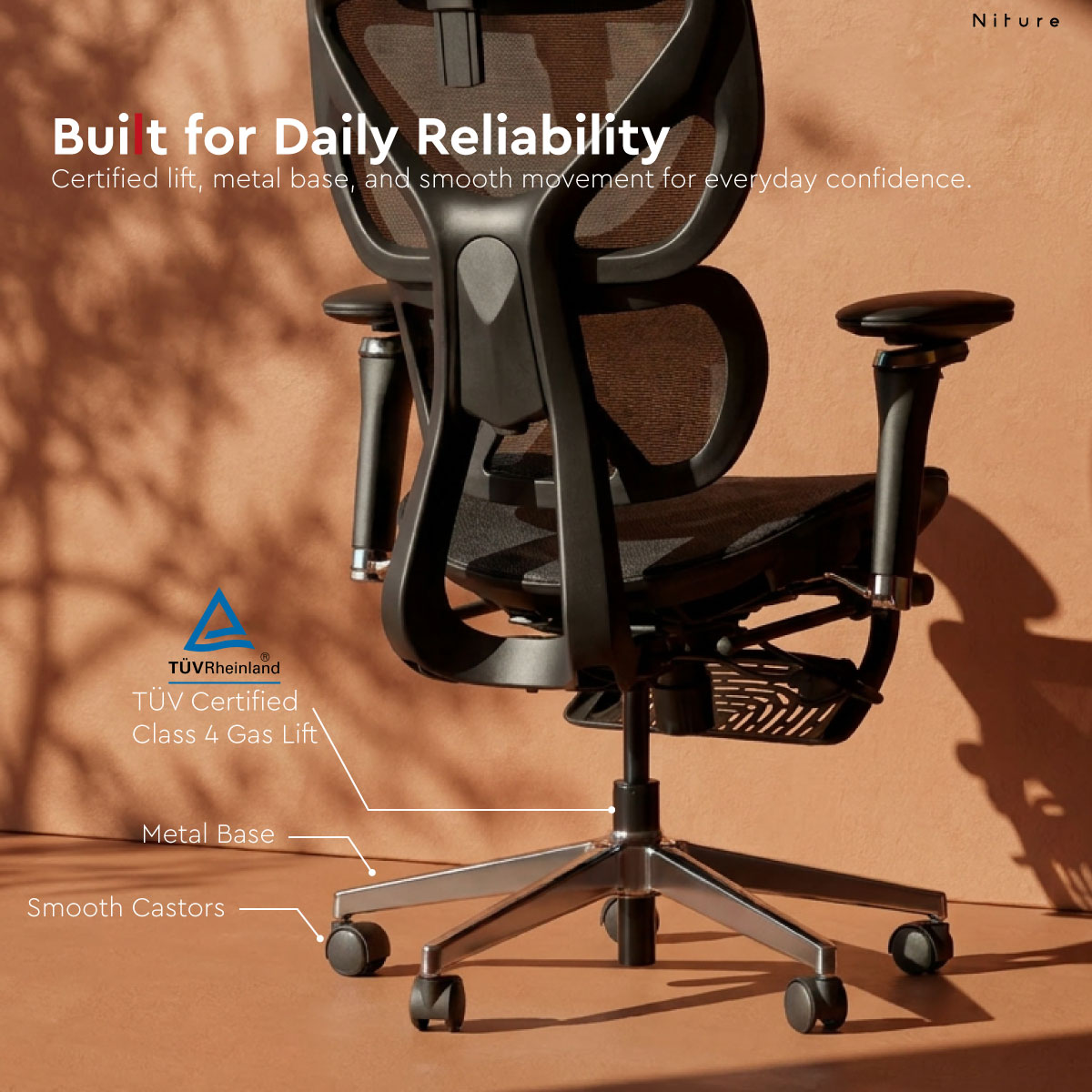
Gas liftTÜV-certified Class 4
BaseChrome-finished metal, five-star
CastorsTwin-wheel
Ownership
Warranty3 years · terms
Showroom trialFree fitting at Niture Puchong

Measurement note: dimensions are measured by hand and may vary slightly between units or production batches. Treat approximate values as a guide and confirm fit by adjusting the chair.

Adjustment Video Guide

Set Up Hammock 1 Around Your Body

Watch how to adjust each part of Hammock 1, then follow the order below. Set it after assembly, and check again once your desk is set up.

Adjust From the Seat Up

Set your legs first, then fine-tune the upper-body support.

  1. Seat height

    Feet flat on the floor, thighs roughly level.

  2. Seat depth

    Support most of the thigh, with a small gap behind the knees.

  3. Lumbar

    Sit fully back. Turn the wheel fully right to fix it, or left to let it flex.

  4. Armrests

    Bring them to your elbows with shoulders relaxed.

  5. Headrest

    Set height, depth, tilt and rotation to meet your neck curve.

  6. Recline & footrest

    Set the tension knob, try the 3 locks, and pull out the footrest to rest.

Final Fit Check

Sit at your actual desk and confirm:

  • Feet stay supported while you work.
  • There's a gap behind your knees.
  • The lumbar meets your lower back without pressing hard.
  • Forearms rest on the armrests, shoulders relaxed.
  • The headrest reaches your neck without pushing your head forward.
  • Screen and desk height don't make you lean or hunch.

No single setting suits every task. Small changes help when you switch between typing, calls, reading and reclining.

Frequently Asked Questions

Hammock 1 FAQ

Common questions about fit, lumbar support, adjustments, materials and how Hammock 1 differs from Hammock 2.

Still unsure whether Hammock 1 fits you?

Compare lumbar feel, seat depth, headrest reach and armrest position in person, instead of deciding from height alone.

Try It in Puchong
What is the main difference between Hammock 1 and Hammock 2?

Hammock 1 and Hammock 2 share the same core ergonomic platform and adjustment system. The main difference is the lumbar support design. Hammock 1 uses Flex-Control Lumbar Support, a one-piece curved single lumbar support that creates a more focused, concentrated and noticeable lower-back contact. Hammock 2 uses twin lumbar sections that create a broader, more wrapping sensation. Neither design is universally better. The better choice depends on your body shape and preferred support sensation.

What height is Hammock 1 recommended for?

Around 158 to 180 cm is a useful starting range for Hammock 1. At about 158 cm the fit is marginal and depends on torso length. Height alone does not determine chair fit: seat depth, thigh length, torso length, lumbar position and headrest reach should also be checked. Users near either end of the range are encouraged to try the chair in person.

Is Hammock 1 suitable for shorter users?

It depends strongly on body proportions. Below about 158 cm, pay particular attention to seat height, usable seat depth and headrest reach. Seated, the seat height measures approximately 39.5–47.5 cm, and the usable seat depth is approximately 44–50 cm, so users with shorter thighs should confirm that comfortable clearance remains behind the knees.

Is the lumbar support adjustable?

Yes. Hammock 1 uses Flex-Control Lumbar Support: one curved lumbar piece with an adjustment wheel at the back. Turn the wheel fully to the right and the lumbar support is fixed. Turn it to the left and the lumbar support starts to flex; the further you turn, the more it can flex, pivoting at the top of the lumbar support up to approximately 30°. The curved contact point sits approximately 14 cm above the seat surface.

How much seat-depth adjustment does Hammock 1 have?

Hammock 1 provides approximately 44–50 cm of usable seat depth across 3 positions, measured from the lumbar contact point to the front edge of the seat. The physical seat pan measures 51 cm wide × 51 cm deep, with a physical seat depth of approximately 50 cm. Physical seat size and usable seat depth are different measurements.

How far can Hammock 1 recline?

Hammock 1 uses a synchronized recline mechanism with 3 locking positions and a maximum recline of approximately 135°. The recline angle is measured between the seat plane and the backrest at maximum recline.

Does Hammock 1 include a footrest?

Yes. Hammock 1 includes a retractable footrest stored beneath the seat. It can be extended during reclined or recovery sitting and retracted again for normal desk work. It is intended as an additional relaxed sitting position rather than a substitute for correct seat and desk height.

Is Hammock 1 a full-mesh chair?

Yes. Hammock 1 uses breathable mesh across both the seat and backrest. The mesh allows more airflow than a thick upholstered surface and provides a flexible sitting surface, which can be practical in Malaysia's warm working environment.

What is the maximum recommended weight for Hammock 1?

The Hammock Series has a maximum recommended load of 110 kg. Weight capacity should be considered together with body dimensions and fit rather than used as the only criterion when choosing a chair.

Can I try Hammock 1 before buying?

Yes. Hammock 1 is available to try at the Niture Puchong showroom, Monday to Sunday, 11 AM–5 PM. Fitting is free and walk-ins are welcome; a typical fitting takes about 30 minutes. You can compare Hammock 1's focused single lumbar support with Hammock 2's broader twin-lumbar feel and check seat depth, armrest position and headrest reach against your own body.

What warranty does Hammock 1 come with?

Hammock 1 comes with a 3-year warranty, subject to Niture's current warranty terms and conditions at https://niture.com.my/warranty-statement/.

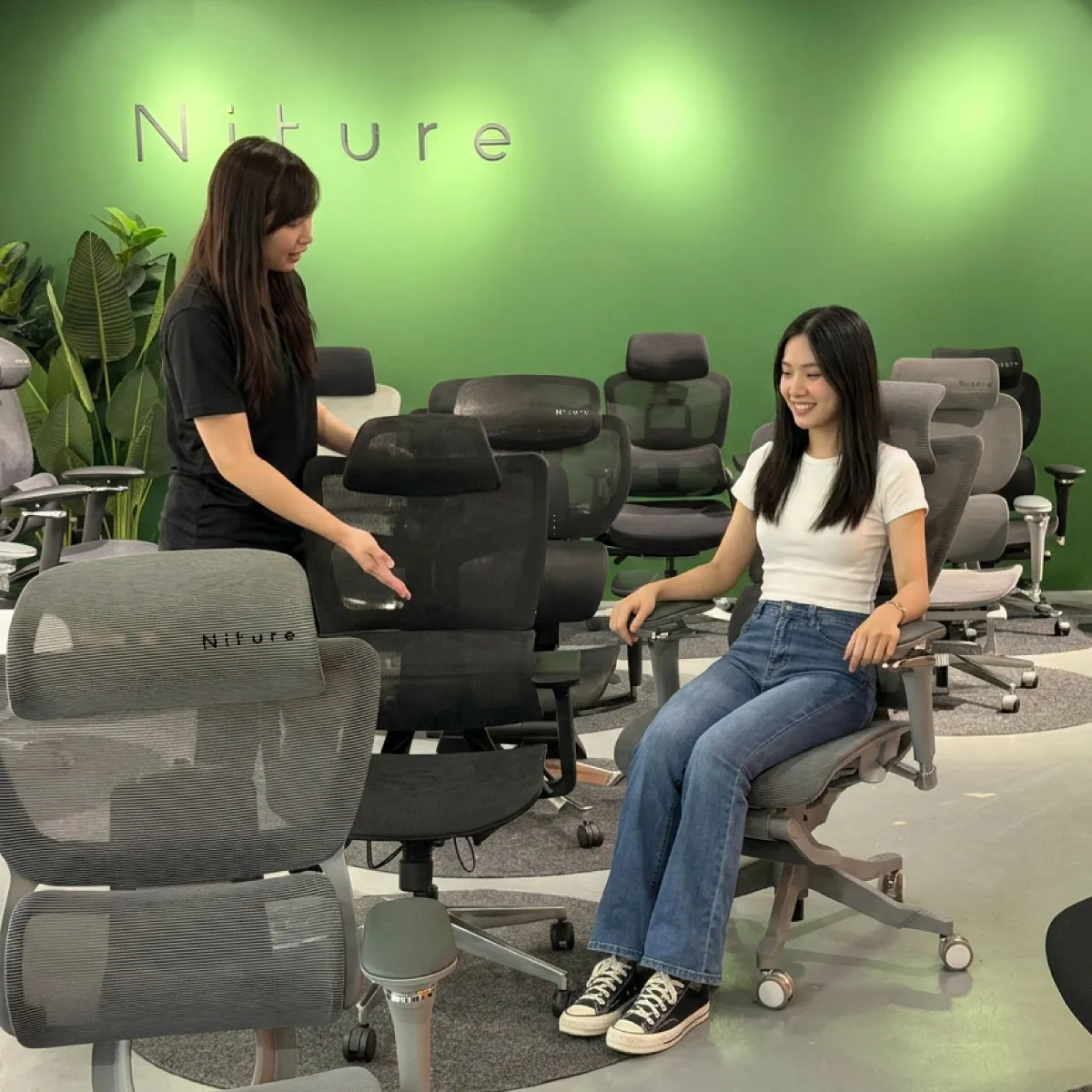
Free Ergonomic Chair Fitting

Feel the Difference Before You Decide

Specs narrow the choice. Your body confirms the fit.

Visit the Niture showroom in Puchong to sit in Hammock 1, compare its Flex-Control lumbar with Hammock 2's twin lumbar, and have the chair adjusted around your own proportions.

Fitting
Free
Takes
≈30 min
Walk-ins
Welcome
Open
Mon–Sun
11 AM–5 PM

No appointment needed for a general fitting. If you'd like a particular consultant, arrange a time in advance.

Illustration of a customer trying an ergonomic chair during a fitting

What to Check in Person

A good trial isn't about the first 30 seconds. Adjust the chair, then check whether its support points match your body.

  1. Compare the lumbar feel

    Sit in Hammock 1 and Hammock 2 back to back. Try Hammock 1's lumbar both fixed and flexing.

  2. Check the six measurements

    Seat height, seat depth, lumbar, armrest height and width, and headrest reach against your body.

  3. Test more than one position

    Sit upright, recline through the locks, move the armrests and try the footrest.

Reviews

There are no reviews yet.

Be the first to review “Hammock 1 Ergonomic Chair”

Your email address will not be published. Required fields are marked *

Not sure which ergonomic chair to choose? Use our smart filter to quickly narrow down options by features, materials, and comfort preferences. Search Now...

Payment Options

Choose the payment method that suits you best. We accept Visa, Mastercard, FPX, and Buy Now Pay Later (BNPL) options.

Enjoy peace of mind with our reliable warranty coverage. Our dedicated support team is always ready to assist with after-sales service. Learn More...

Shipping & Delivery

Get your ergonomic furniture delivered safely and on time. We provide fast, secure, and trackable shipping options to ensure your order reaches you in perfect condition.

36% OFF

Original price was: RM1,399.00.Current price is: RM899.00.

Not sure which ergonomic chair to choose? Use our smart filter to quickly narrow down options by features, materials, and comfort preferences. Search Now...

Payment Options

Choose the payment method that suits you best. We accept Visa, Mastercard, FPX, and Buy Now Pay Later (BNPL) options.

Enjoy peace of mind with our reliable warranty coverage. Our dedicated support team is always ready to assist with after-sales service. Learn More...

Shipping & Delivery

Get your ergonomic furniture delivered safely and on time. We provide fast, secure, and trackable shipping options to ensure your order reaches you in perfect condition.